

SmartIP Trademark Desk · Student & Startup Brand Series
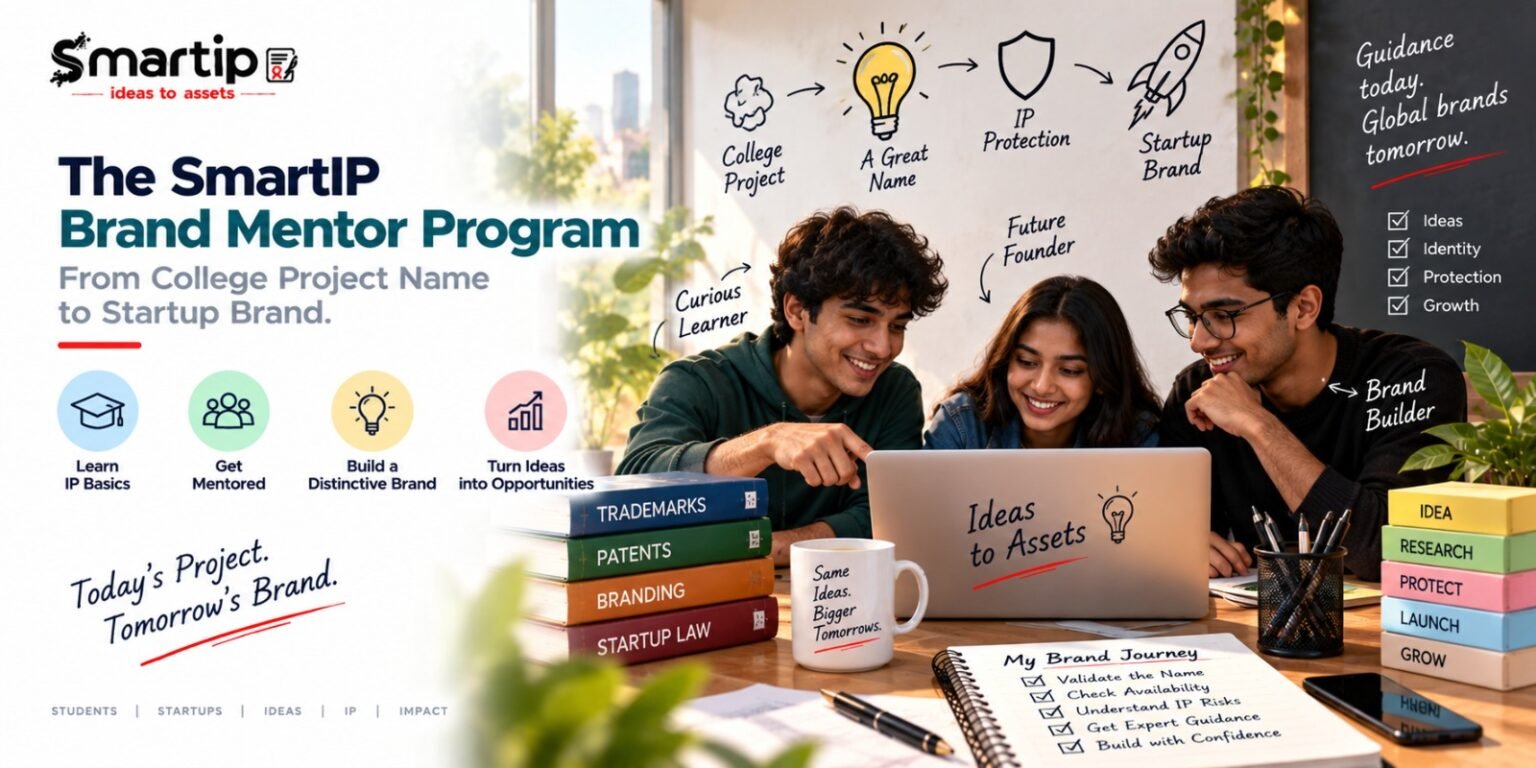
A college project name can become a startup brand long before anyone formally decides that it should. The SmartIP Brand Mentor Program is designed to help student ventures and early-stage founders move from naming to clearance, ownership, class strategy, filing and disciplined brand growth—with faculty and incubators supporting the process rather than treating trademark filing as an afterthought.
Why student brands need mentoring before they need a filing
Student teams often create names casually. A robotics club picks a nickname, a software project uses a catchy acronym, or a final-year project receives a name just before a competition. If the project remains academic, that may be enough. But once the team wins an incubation grant, starts a social page, sells a pilot product or incorporates a company, the informal name begins to carry commercial value.
The challenge is that brand decisions made casually can become expensive later. The name may be descriptive, too similar to an earlier mark, owned by the wrong person, tied to a domain controlled by a departing member, or visually represented by a logo whose copyright was never assigned properly.
The SmartIP Brand Mentor Program is meant to intervene before those problems become embedded. It teaches the team to see a brand as a combination of identity, legal rights, ownership, customer recognition and business strategy.
Discover
What should customers remember about the venture?
Create
Generate several distinctive candidate names.
Clear
Search marks, domains, companies and the market.
Own
Fix the mark, logo, domain and account ownership.
Protect
Choose mark type, classes, owner and filing route.
Grow
Use, monitor, renew and expand the brand deliberately.
Stage 1: decide whether the project name should become a brand
Not every project title deserves a trademark application. A temporary academic label may have no long-term commercial role. The first mentor question is therefore strategic: will customers, investors, partners or users actually encounter this name as the identity of a product or service?
If the project is evolving into a venture, the team should decide whether the existing name fits the business it may become. A narrowly descriptive academic title can become awkward when the startup expands. A name tied to one campus joke may not travel well internationally. A technical acronym may be difficult to pronounce or remember.
Mentoring at this stage is not legal clearance yet. It is brand architecture: what should the market remember, and will the name still make sense if the first prototype becomes a broader product platform?
Stage 2: teach students to create several candidates
One of the easiest ways to improve trademark outcomes is to stop beginning with one final name. A naming session should generate several candidates and compare them for distinctiveness, memorability, pronunciation, future expansion and legal searchability.
This reduces emotional attachment. If a search later reveals a material concern, the team can move to another candidate without feeling that months of identity work have been lost. The approach also teaches students that brand creation is iterative, just like product development.
Faculty mentors can contribute by challenging whether the name accurately reflects the project’s future scope, while founders retain ownership of the commercial decision. A faculty member does not need to become the trademark owner merely because they helped the team think through the name.
Stage 3: turn clearance into a learning exercise
Students should learn that trademark searching is not equivalent to typing an exact word into a search box. A mentor can demonstrate similarity through examples: words that differ by one letter, marks with similar pronunciation, names sharing a distinctive dominant element, or brands used in commercially related fields.
The search should include the trademark register, ordinary market use, company names, domains, app stores and major social platforms. The objective is not to certify zero risk. It is to develop a reasoned view of what earlier rights or market use might matter.
This is particularly valuable for startup education because the same skill can be applied later when the venture creates product names, sub-brands or international identities.
The project nickname that survived incorporation
A robotics team uses an informal nickname for two years. The name appears on competition certificates, GitHub pages and social posts. When the students incorporate a company, they assume the nickname should automatically become the company’s brand.
The mentor review reveals three issues: no structured trademark search has been done, the logo was created by a former volunteer, and the main domain is registered personally to a team member who is leaving.
By resolving these issues before the first funding round, the team converts an informal identity into a cleaner commercial asset.
Stage 4: ownership should be fixed before filing
Student teams are fluid. Members graduate, join employers, leave the venture or change roles. That makes ownership especially important. The trademark, logo, domain and social accounts should not be spread across individuals without a clear plan if the brand is intended for a startup.
Where the company has already been incorporated, filing in the company’s name may often create a cleaner long-term structure, subject to the actual facts and strategy. If the company does not yet exist, the team should document how pre-incorporation brand assets will be handled.
Logo ownership should also be addressed through the appropriate written terms with designers. The trademark filing and copyright ownership in the artwork are related but distinct issues.
Stage 5: teach class strategy through the business model
The mentor program should avoid teaching trademark classes as memorisation. Instead, students should map what the venture actually offers. Is it selling a physical device, downloadable software, hosted software, education, consultancy, retail services or research services?
IP India’s current guidance confirms that goods and services are classified under the Nice system, with Classes 1–34 for goods and 35–45 for services. A technology venture may therefore need to consider more than one class, but only where the activities genuinely justify it.
This exercise teaches commercial thinking. Students begin to understand that “we are a tech company” is not a sufficient description of a business for trademark purposes.
Stage 6: filing should be linked to a real brand decision
Once the candidate has been cleared sufficiently, ownership is understood and the business scope is mapped, the team can make the filing decision. That may involve a word mark, a logo/device mark or both, depending on the strength and stability of the brand assets.
Under the current Indian process, a new application is filed in Form TM-A. The application is examined, may receive objections, and if accepted is published in the Trade Marks Journal. Third parties may oppose within the applicable four-month period after publication.
The mentor should therefore explain that filing is the beginning of prosecution, not the final certificate. Students learn to track the process and understand why deadlines matter.
How faculty members can participate constructively
Faculty can add considerable value without turning the trademark program into a legal classroom. They can challenge whether a brand fits the underlying technology, help students understand the market, connect ventures to incubators and identify when the project is becoming commercially serious enough for a brand review.
Faculty should avoid assuming ownership merely because the venture originated in a department. Trademark ownership should follow the actual commercial and institutional arrangements. University policy, incubation agreements and sponsorship terms may need to be reviewed where relevant.
The best faculty role is to make sure branding decisions are not postponed until after demo day or incorporation.
How incubation centres can use the program
An incubation centre can introduce a brand gate before major public launch. A short checklist can ask whether the venture has more than one candidate name, whether a preliminary search has been performed, whether the domain and logo are controlled, and whether the filing entity has been identified.
This is inexpensive compared with later rebranding. It also helps the incubator present ventures more professionally to investors and corporate partners. A startup that can explain who owns its brand and what has been filed sends a stronger diligence signal than one with scattered assets.
Incubators can also maintain reminders for application status and renewals, although each venture should ultimately take responsibility for its own portfolio.
The Brand Mentor Program should not promise registration
A mentoring program is not a guarantee that a mark will be accepted or that no third party will object. The Registry examines applications under the Trade Marks Act and Rules, and third parties may have earlier rights or grounds to oppose.
The mentor’s role is to improve the quality of the decision: choose stronger candidates, search more intelligently, describe goods and services accurately and file in a cleaner ownership structure. That reduces avoidable risk but does not eliminate legal uncertainty.
This distinction matters ethically. Students should learn that professional IP work manages uncertainty rather than selling certainty.
What students should bring to a Brand Mentor session
- Three to five candidate names. Avoid arriving with only one untouchable favourite.
- A plain-language description of the venture. What do customers actually receive?
- Target users and markets. Campus, India-wide, B2B, consumer or international?
- Existing brand assets. Domains, logos, handles, packaging and app names.
- Ownership information. Who created the logo and who controls the accounts?
- Launch timeline. When will the name become public?
What success should look like
Success is not measured by how many student trademarks are filed. A strong outcome may be a team deciding to rename before launch because the original name was weak. Another team may decide that the project is not yet a real venture and postpone filing. A third may complete clearance and file a carefully scoped mark that later supports company growth.
Better measures include fewer emergency renames, cleaner ownership, better class specifications, more disciplined evidence of use and clearer international expansion decisions.
The program should create brand literacy that remains useful long after the first venture.
From campus brand to startup portfolio
When a student venture succeeds, the brand architecture often expands. The company may introduce a second product, an enterprise edition, a training programme or an international service. The original mentor framework can then be reused: create, clear, own, protect and grow.
At this stage the company should maintain a simple trademark register. Record each mark, owner, class, territory, status, filing date, renewal date and evidence of use. The portfolio should reflect real commercial importance rather than every internal product nickname.
This is how a student exercise becomes an institutional habit for the startup.
A semester-based Brand Mentor model
The program can fit naturally into an academic calendar. During the first month, teams identify whether a project name has commercial potential and generate alternatives. In the second month, they conduct preliminary clearance and map domains, handles and ownership. Before the main demo day or incubation pitch, the team decides whether the name should be filed and in whose name.
This timing is useful because the brand evolves alongside the product. Students do not waste filing budgets on temporary project titles, but they also avoid arriving at incorporation with a name that has never been searched. The mentor program becomes a practical checkpoint rather than a separate legal workshop.
Brand mentoring should connect with the invention and design mentors
A startup rarely creates only one kind of IP. The same college team may have a patentable mechanism, a distinctive product appearance, original software and a new brand. Brand mentoring therefore works best when it is coordinated with the broader SmartIP mentor ecosystem.
For example, a team preparing to reveal a product at an exhibition may need both a patent-before-publication review and a trademark clearance. A hardware company may need design registration for appearance and a mark for the product name. Coordinating those decisions avoids the false idea that filing one right automatically protects the entire venture.
How to involve alumni and industry mentors
Alumni founders and industry mentors can add a commercial lens by testing whether a name is memorable, credible and scalable. They can explain how difficult rebranding becomes after customer acquisition or how brand ownership appears during diligence. Their role should remain advisory, while legal clearance and filing decisions are handled properly.
For colleges, this creates a useful bridge between entrepreneurship education and IP literacy. Students learn that a brand is neither just a logo nor just a registration; it is a business asset that has to be chosen, owned, used and protected deliberately.
How the mentor program can support investor readiness
When a campus startup enters diligence, investors may ask who owns the name, whether a search was performed, which applications are pending, who created the logo and whether important domains are controlled by the company. A team that has completed the Brand Mentor process should already have most of this information organised.
The program can therefore end with a simple brand dossier: candidate-selection record, clearance summary, ownership documents, application details, domain and handle control, and evidence of early use. The dossier does not replace legal due diligence, but it dramatically reduces the amount of history founders must reconstruct later.
That also changes how students think about IP. The trademark is no longer viewed as a certificate for a competition file; it becomes part of the commercial infrastructure of the venture.
The mentor program can also create a reusable campus resource. With confidential details removed, colleges can build examples showing why some names were changed, why class mapping mattered, and how ownership was cleaned before incorporation. Future student teams then learn from real venture decisions rather than abstract trademark definitions. Over time, that can make brand literacy part of the innovation culture rather than an emergency step after launch.
For colleges, the broader benefit is educational. Students who learn to distinguish a project title from a commercial brand also become better prepared for entrepreneurship, licensing and investor conversations. They understand that identity has to be created, cleared, owned and maintained with the same seriousness as other startup assets.
It also gives faculty and incubators a common vocabulary for discussing commercial identity with student founders before launch decisions become difficult.
SmartIP takeaway
The SmartIP Brand Mentor Program treats trademark strategy as part of venture development. Students learn to choose names deliberately, search before attachment, understand ownership, connect classes to the business model and file before brand investment becomes difficult to reverse.
For colleges and incubators, the program creates a practical bridge between innovation and commercial identity. For founders, it produces a cleaner brand foundation that is easier to explain to customers, investors and future partners. The goal is not simply to register a name. It is to build a name worth protecting.
Official sources
- IP India — Basics of Trademarks
- IP India — Trademark Filing Process
- IP India — Trade Marks Rules, 2017
This article is educational. Registrability, ownership, opposition and filing strategy depend on the mark, goods/services, earlier rights and specific facts.