

SmartIP Copyright Desk · Student Creator Series
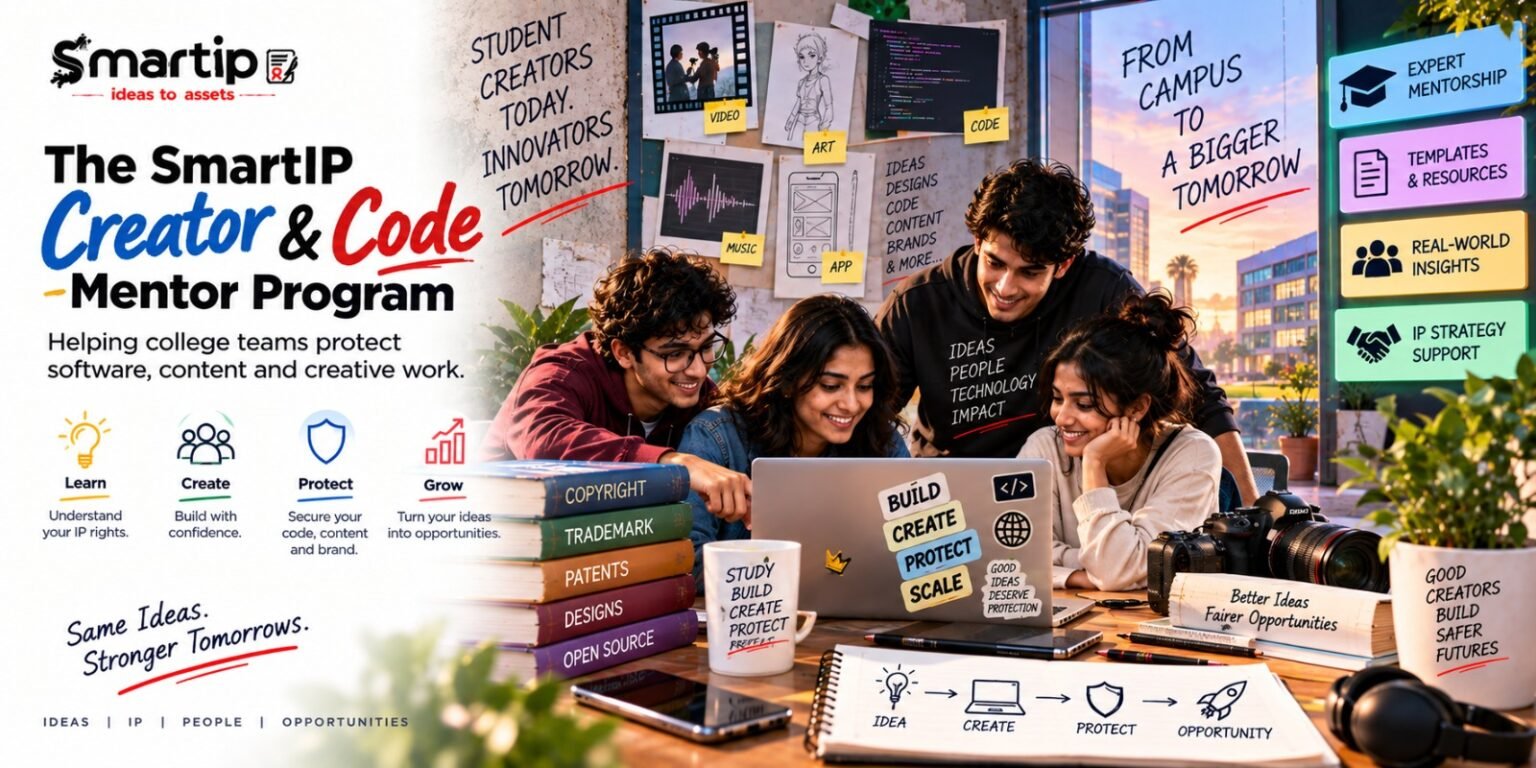
Student innovation increasingly produces code, videos, graphics, reports, datasets, course material and AI-assisted content alongside technical inventions. The SmartIP Creator & Code Mentor Program helps campus teams document creators, ownership, licences and publication choices before projects become startups or commercial assets.
College projects create more copyright than students realise
A final-year project may contain source code, CAD drawings, photographs, diagrams, user-interface graphics, technical reports, presentation slides, a demo video and website content. A design club may create templates and photographs. A student startup may commission a logo. A research group may build software and documentation. Each output can raise copyright or licensing questions even though the team thinks of the work as one “project”.
The SmartIP Creator & Code Mentor Program is intended to make those rights visible. It does not begin with registration. It begins by cataloguing what was created, who created it, whether third-party material is embedded, and how the team wants the work to be used.
This is particularly important when the project may become a startup. Ownership questions that are easy to solve during college become harder after students graduate, contributors leave and investors ask for evidence.
Identify code, content and creative output.
Record creators, versions and third-party sources.
Resolve ownership and licence questions.
Open source, license, assign or retain.
Move clean assets into the startup or market.
Stage 1: create an asset map
The first mentor exercise is simple: list everything the project has produced. Separate source code from documentation, photos from graphics, video from music, and original material from third-party material. This prevents the team from talking vaguely about “the app” when the app actually contains many rights.
For software, identify repositories and major modules. For content, identify final and working files. For creative assets, identify the designer or photographer. For AI-assisted outputs, record the tool and material human contribution where the asset is commercially important.
The asset map becomes the foundation for ownership, licensing and commercialisation decisions.
Stage 2: trace who created what
Student teams change over time. A member may join only for the UI. Another may write a key backend module. A volunteer may photograph the prototype. A faculty lab may supply a diagram. Without records, the team may later remember ownership differently.
The program encourages a simple contribution register: asset, creator, date, role and any agreement or institutional context. The register is not intended to create bureaucracy. It preserves facts while everybody still agrees on them.
This is especially useful when the project becomes a startup and the company needs assignments or licences from the correct people.
Stage 3: identify third-party material
Projects frequently contain material students did not create: open-source libraries, stock images, fonts, music, templates, datasets and AI outputs. “Free download” does not mean “free of copyright conditions”.
The mentor teaches teams to record the source and licence. A permissive software licence may be easy to comply with; another licence may have significant redistribution obligations. A photograph may be available only for non-commercial use. A font licence may not permit embedding or redistribution in every context.
The habit of checking licences is one of the most commercially valuable skills a student developer can learn.
The design club that became a subscription platform
A college club spends three years creating templates, photographs and tutorials. Two students later propose turning the archive into a paid platform.
They discover that early material has no creator record, some photographs came from “free” websites and the club logo was created by a former member who has graduated.
The mentor process helps catalogue the assets, contact creators, replace uncertain third-party material and establish contributor terms before commercial launch.
Stage 4: understand university and sponsor policies
Campus work may be affected by institutional IP policies, funded-research agreements, incubation terms or collaboration contracts. Students should not assume that every work created at college belongs automatically to the student or automatically to the university.
The mentor helps the team identify the relevant policy and escalate legal interpretation where required. This is particularly important for software or content developed using sponsored funds or confidential industry material.
Clarity at this stage prevents later conflict between student founders, faculty and the institution.
Stage 5: decide whether the work should be open or proprietary
Open sourcing can be a powerful strategy. It can build community, accelerate adoption and support research. But release should be deliberate. The team must have authority to license the code and should choose a licence appropriate to the project’s goals.
Other works may remain proprietary because the startup intends to license them commercially. Some documentation may be public while core software remains closed. There is no universal answer.
The program teaches students to connect licence choice with business and research objectives rather than treating public GitHub upload as the default.
Stage 6: use written contributor and contractor terms
If a team accepts outside contributions, clear contributor terms can reduce uncertainty about the project’s right to distribute or relicense the material. If freelancers build core assets, written agreements should address copyright ownership or licensing.
Section 19 of the Copyright Act makes written assignment requirements important where rights are transferred. Students do not need to memorise the section, but they should understand why an invoice or verbal promise may be insufficient for a commercially important work.
Simple documentation early is far easier than reconstructing permission after a dispute.
AI-assisted creation needs its own provenance habit
Students increasingly use AI for code, images, writing, music and video. The program does not ban this. It asks the team to understand tool terms, protect confidential inputs and preserve human contribution for important assets.
If a commercially important image was heavily edited by a student after generation, keep the working files. If AI helped produce code, run normal security and licence review. If a research project uses AI to generate text, comply with academic disclosure rules.
Provenance is the central habit: know how the asset came into existence.
Copyright registration is optional, but evidence is not
Qualifying copyright generally arises automatically. Registration can still be strategically useful for certain high-value works, but the mentor program first focuses on evidence: drafts, repository history, source files, contracts and publication dates.
Students should not confuse “registered” with “owned”. A registration strategy is strongest when the underlying chain of creation and title is already clear.
The same applies to startups. Formal filings cannot repair every ownership gap created earlier.
How faculty members can help without taking over
Faculty can improve project structure, identify literature, review originality and help students understand institutional policy. They may also contribute copyright works themselves. The contribution should be recorded honestly rather than assigned based on hierarchy.
A mentor should avoid rewriting the entire project or creating the core asset simply to make the student work appear stronger. The objective is to develop student capability.
Where faculty and students co-create material, the commercialisation plan should reflect actual contribution and applicable policy.
How incubation cells can use the program
Incubators can make creator and code review part of startup readiness. Before a grant or investor introduction, ask whether the venture knows who owns the code, whether contractor rights are documented, which open-source licences apply and whether major creative assets have clean provenance.
This creates a useful triage system. High-risk projects can receive deeper legal review; lower-risk teams can proceed with a clean checklist.
It also teaches founders that IP diligence begins before the funding round.
What students should bring to a mentor session
- repository or project list;
- creator/contributor names;
- third-party libraries, photos, fonts or music;
- AI tools used materially;
- university or sponsor policy information;
- existing freelancer or contributor agreements;
- commercialisation or open-source plans.
The goal is to make the session practical, not theoretical.
How a project moves into a startup
Before incorporation, identify the assets the future company will need. After incorporation, document assignments or licences where required. Move important repositories and accounts into company control. Keep open-source and third-party licence records with the product documentation.
This creates a clean transition from student project to business asset. Investors can see that the company controls the code and content it relies on.
The same process can support licensing to an existing company if the students do not want to build a startup.
A semester-long mentoring model
During the first month, the team inventories assets and contributors. In the second month, it reviews open-source, stock and AI-assisted material. Mid-semester is the right time to resolve contributor terms and understand institutional policy before publication or commercialisation decisions are made.
Before the final showcase, the mentor asks whether code will be open sourced, whether videos or graphics can be published and whether a startup will need assignments. By the end of the semester, the team should possess a clean creator register and a short commercialisation plan.
This sequence keeps copyright integrated with project development rather than pushing ownership questions into the final week.
How to measure whether the mentor program is working
Success is not the number of copyright registrations filed. Better measures include the percentage of projects with clear creator records, the number of licence problems identified before launch, the percentage of startups with clean assignments, and the number of teams making deliberate open-source decisions.
Another measure is student confidence. A team should be able to explain which assets it owns, which it licenses and which it cannot commercialise without additional permission.
That knowledge is the real educational outcome.
Build a campus creator register before graduation season
Graduation creates a predictable ownership risk because team members disperse quickly. A college can reduce this by asking project teams to complete a creator register before the final semester ends. The register should list major code repositories, visual assets, reports, videos and external material, together with the people responsible for each.
If a project is likely to continue through an incubation cell or startup, missing contributor permissions can then be resolved while everybody is still reachable. The process also gives students a practical lesson in chain of title and makes later commercialisation less dependent on memory.
Faculty mentors can review the register for completeness without deciding legal ownership unless the institution has an established policy and process.
Mentoring should connect copyright to publication strategy
Students often publish code, reports and videos because visibility helps competitions and placement. Publication can be valuable, but it should be intentional. A public repository may communicate an open-source licence, while a public report may reveal content that a future startup would prefer to commercialise differently.
The mentor therefore asks what the team wants each asset to achieve. Should the code invite contributions? Should the tutorial be freely shared? Should the dataset remain controlled? Should the project name become a startup brand? These questions turn publication from an automatic final step into a strategic choice.
This also helps students understand that openness and commercialisation are not opposites. A project can open-source one layer while retaining proprietary rights in another.
Create simple rules for clubs and student societies
Clubs often create logos, photographs, event videos, websites and repositories over several years. Membership changes constantly, which makes ownership difficult to reconstruct later. A lightweight club policy can state how official assets are created, credited, stored and licensed to the organisation.
The goal is not to impose complex legal documents on casual student activity. It is to distinguish personal creator work from official club assets and to make sure that future committees can continue using the material lawfully.
If a club later spins out a commercial venture, the team can then identify which assets belong to the club and which require new permissions.
A copyright mentor should know when to escalate
Some issues are too important for a checklist: disputed ownership, major open-source licence questions, commissioned films, international content licensing or AI training on third-party works may require specialist legal review. The mentor’s role is partly to recognise that threshold.
Good mentoring therefore does not pretend that every answer is simple. It gives the student enough structure to identify the issue, preserve the evidence and seek the right advice before making an irreversible decision.
Build copyright literacy into project evaluation
Project juries and incubation panels often ask about novelty, market size and technical feasibility but overlook ownership of code and creative output. Adding two simple questions can change behaviour: who created the key assets, and which third-party material is being used?
Students quickly learn that a polished prototype is not commercially ready if the team cannot explain its software licences, logo ownership or content sources. This does not make evaluation more legalistic; it makes it more realistic.
Departments can also reward good documentation. Teams that maintain creator registers, licence records and clean repositories demonstrate professional engineering practice even when they do not seek copyright registration.
Use mentoring to prepare for industry collaboration
When an external company wants to test or sponsor a student project, the copyright record becomes immediately useful. The parties can identify background code, new deliverables and material that should remain available for academic use.
Clear documentation helps the college negotiate from facts rather than assumptions. It also protects students from accidentally giving away unrelated work and protects the company from receiving assets the students had no right to license.
Keep the mentor process lightweight enough to survive
A copyright system that requires students to complete long legal forms for every image or code commit will be ignored. The Creator & Code Mentor Program should therefore use simple tools: one asset register, one licence list, one contributor record and one publication decision sheet.
The objective is repeatability. Students should be able to maintain the record during normal project work, not recreate it at the end. That makes the information more accurate and creates habits they can carry into startup or professional environments.
The same lightweight records also help when team membership changes. A new student can understand which assets are official project material, which are personal contributions, and which are third-party resources subject to licence conditions. Continuity improves without turning the project into a legal exercise.
A mature student team should therefore leave college with more than a prototype. It should leave with a clear record of creators, licences, publication choices and the rights needed for the project’s next stage.
SmartIP takeaway
The SmartIP Creator & Code Mentor Program treats copyright as part of the innovation process. Students learn to catalogue assets, trace creators, understand licences, document ownership and choose deliberately between open and proprietary models.
Those habits make projects easier to commercialise, license or move into a startup. More importantly, they teach students that creativity and code become business assets only when the organisation can explain where they came from and what rights it has.
Official sources
This program description is educational. Ownership and licensing questions require review of the actual works, agreements, policies and facts.