

SmartIP Copyright Desk · AI & Creativity Series · Updated September 2026
AI can accelerate writing, images, code and design, but copyright questions sit at several points in the workflow: inputs, tool terms, human contribution, output similarity and commercial reuse. This SmartIP guide gives Indian teams a practical process without pretending that global law is settled.
Do not ask only “Who owns the AI output?”
That question is too narrow. A commercially important AI-assisted work may raise at least five separate issues: what material entered the system, whether the input was authorised, what the tool’s contract says, what human creativity shaped the final work, and whether the output is too close to third-party material.
A startup that looks only at output ownership may miss confidentiality and training-data issues. A creator who looks only at human authorship may miss platform terms. A developer who looks only at copyright may miss security and open-source concerns.
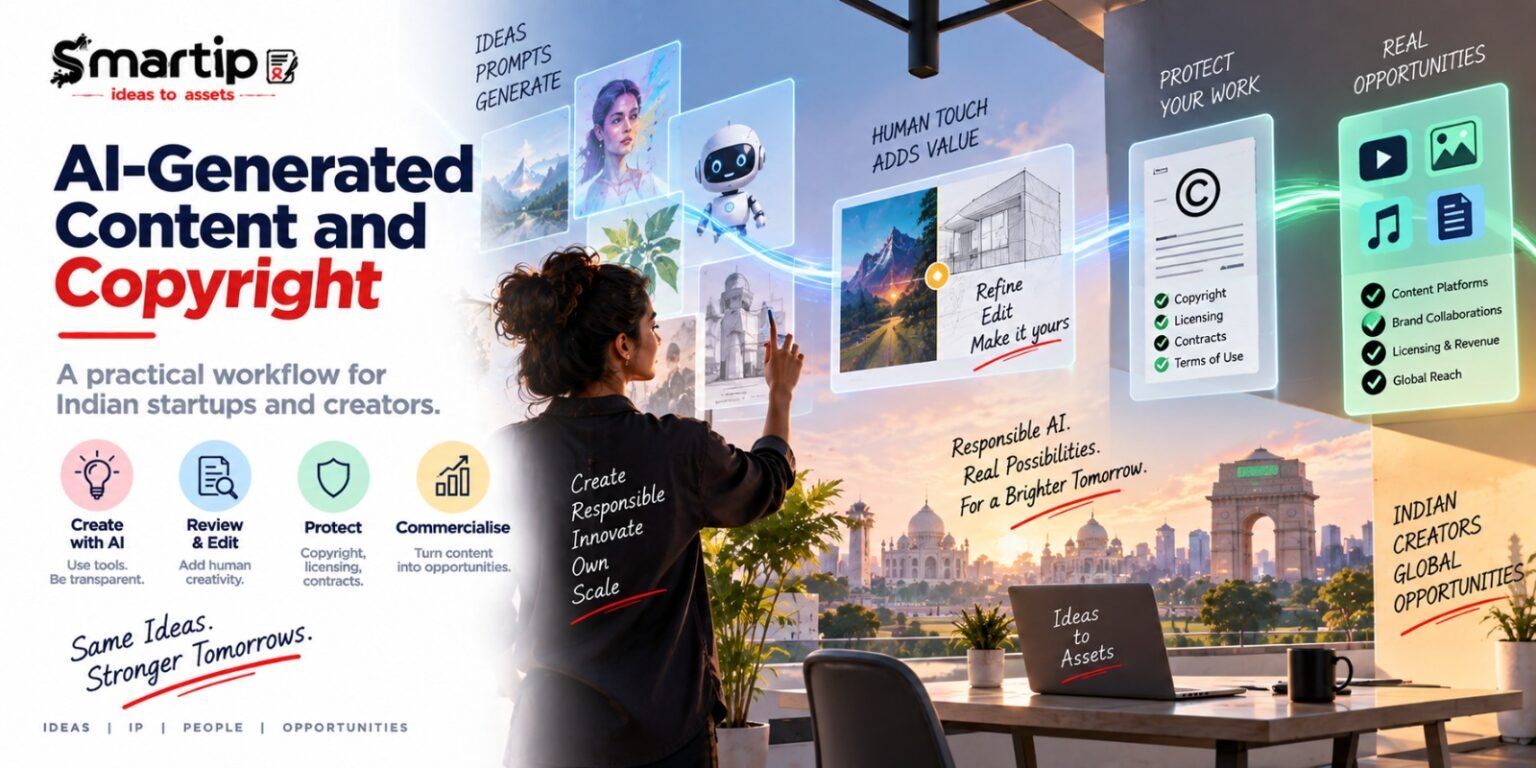
The practical workflow should therefore review the whole creation chain.
Check source, rights and confidentiality.
Understand retention, training and output terms.
Document creative choices and edits.
Check similarity, licences and risk.
Publish, license or commercialise deliberately.
Step one: classify the input before using the tool
Inputs can include a short generic prompt, unpublished company content, customer data, source code, photographs, books, music or a collection of third-party works. The risk profile is very different in each case.
Do not assume that material is safe merely because it is available online. Public access does not automatically create permission to reuse, upload or train on the work. Licence terms, statutory exceptions, contractual obligations and jurisdiction may all matter.
For startups, create a simple rule: high-value confidential or customer material should not enter an unapproved AI system.
Step two: read the AI tool’s terms before the campaign launches
Tool terms may address ownership claims, licences, retention, model training, enterprise controls and acceptable use. These provisions change over time, so teams should not rely on what a colleague remembers from last year.
The legal significance also depends on the asset. A rough internal brainstorming image may not justify deep review. A hero image used globally across advertising and product packaging may justify much more care.
Companies should therefore classify AI uses by business importance and risk.
Step three: preserve meaningful human contribution
International policy discussions continue to focus on human authorship. The U.S. Copyright Office’s 2025 report is one influential example, concluding under U.S. law that AI-assisted works can contain protectable human authorship where a person determines sufficient expressive elements, while mere prompting alone is not enough.
Indian law must be analysed separately, but from a business perspective the lesson is valuable: preserve human creative choices. Keep drafts, sketches, layer files, edits, selections and arrangement decisions for important works.
A one-click output gives the company a weaker provenance story than a documented human creative process.
AI creates the draft; the designer creates the commercial asset
A startup generates an initial product illustration with an AI tool. Instead of publishing the first output, its designer redraws key components, changes composition, creates original typography and adds product-specific visual elements.
The working files show a substantial human creative process. The company also records the tool and checks the applicable terms.
This does not guarantee any particular legal conclusion, but it produces a far better commercial provenance record than an undocumented one-click generation.
Step four: do not confuse attribution with permission
Creators often assume that crediting the original photographer, musician or illustrator makes reuse lawful. Attribution can be a licence condition, but credit alone does not automatically create permission.
If an AI workflow deliberately uses third-party content as input, the team should identify the relevant licence or legal basis. The same applies to human-created projects.
“We gave credit” should never substitute for rights clearance.
Step five: review output similarity before high-value use
Generative systems can sometimes produce material that resembles existing works, styles or characters closely enough to create commercial concern. Important outputs should receive human review before publication.
Image search, code comparison, brand clearance and specialist review may be appropriate depending on the asset. The point is not to guarantee that nothing similar exists; it is to catch obvious risk before the material becomes central to a campaign or product.
High-value assets deserve more review than disposable internal drafts.
AI-generated text still requires editorial ownership
AI can generate articles, product descriptions, scripts and reports quickly. But raw generated text may contain factual errors, copied phrasing, invented citations or a generic voice inconsistent with the brand.
A human editor should verify facts, rewrite important sections and take responsibility for the final publication. For educational and professional content, source checking is essential.
The business should also decide whether readers need disclosure of AI assistance based on sector, platform, policy and trust expectations.
AI-generated images need provenance as well as aesthetics
Marketing teams may generate dozens of images and lose track of which tool or source material was used. For commercially important visuals, record prompt context, source inputs, tool version where feasible and subsequent human edits.
If a person uploads a client photograph or confidential product design as a reference, confidentiality and permission questions arise before output copyright is even considered.
A visual asset register can therefore include both human designers and AI-assisted assets.
AI-generated code should enter a software review pipeline
Generated code is not merely creative content. It can introduce security vulnerabilities, licence concerns and functional defects. It should undergo ordinary code review, testing and dependency analysis.
Developers should also avoid placing confidential source code into public tools without approval. Enterprise settings and contractual protections vary.
The fastest code is not necessarily the cheapest code if the company later has to rewrite it during diligence.
Model training creates a separate governance project
A company using AI outputs is not the same as a company training or fine-tuning a model. Training projects need a systematic dataset inventory: source, rights, licence, permitted purpose, privacy status and removal mechanisms where applicable.
WIPO’s current AI/IP resources encourage organisations to consider rights in training materials and outputs. The U.S. Copyright Office has separately analysed generative-AI training. These sources demonstrate the complexity of the issue rather than providing one global rule.
Indian businesses should obtain specific advice for high-value training activity.
Contracts with agencies should disclose AI use where it matters
If a marketing agency or software contractor may use generative AI, the client should decide whether that is acceptable and whether disclosure is required. Contracts can address third-party material, tool use, warranties, indemnities and delivery of working files.
A company should not discover during a dispute that the agency created the core brand asset through an unknown tool with no provenance record.
Good contracts make AI use visible enough to manage.
Create an approved-use matrix
One practical startup policy is to divide AI use into low, medium and high risk. Low risk might include generic brainstorming. Medium risk might include internal code assistance or draft marketing copy. High risk might include customer-confidential inputs, training datasets, regulated decisions or flagship commercial creative.
Each category can have different approval and documentation requirements. This keeps policy proportionate and avoids banning useful tools unnecessarily.
The system should be simple enough for teams to follow during normal work.
What student creators should do
- keep important drafts and edit history;
- check whether course or competition rules require AI disclosure;
- avoid uploading confidential project material into public tools;
- record third-party images, music, fonts and datasets;
- understand that public availability is not the same as copyright permission.
These habits are useful whether the project becomes commercial or remains academic.
What startups should do
Adopt an approved-tool list, review vendor terms, define prohibited inputs and create provenance standards for high-value assets. Require human review of generated code and customer-facing content.
Maintain an asset record linking major AI-assisted works to the person responsible for final approval. Where ownership is business-critical, consider whether human recreation or deeper documentation is appropriate.
Finally, do not make global legal claims. Copyright approaches to AI vary across jurisdictions and continue to evolve.
Build an evidence file for flagship AI-assisted assets
For a major campaign image, core software module or high-value report, create a small evidence file containing the human working drafts, tool information, key source assets, approval history and licence notes. The file does not need to preserve every prompt; it should make the creation process understandable later.
This evidence can support internal governance, contract discussions and future rights analysis. It also encourages teams to distinguish disposable AI output from assets the business expects to exploit for years.
Provenance should therefore scale with commercial importance: the more valuable the asset, the better the creation record should be.
Different AI use cases need different copyright controls
A marketing team generating background concepts does not create the same risk as a company training a commercial model on a large archive of third-party works. Likewise, an engineer using AI to suggest test code is different from an agency generating the final logo. Policies should recognise these differences.
For low-risk uses, basic human review may be enough. For higher-value creative assets, preserve provenance and working files. For model training, build a dataset-rights process. For customer-confidential inputs, require approved enterprise tools and contractual controls. A single blanket rule is usually either too weak or too restrictive.
Risk-based policy also makes compliance easier because employees understand why some activities need more scrutiny than others.
How to brief an external creative agency using AI
The client should decide in advance whether generative AI is permitted, restricted or subject to disclosure. The brief can require the agency to identify AI tools used materially, disclose third-party source assets, preserve editable files and confirm that it has the necessary rights to deliver the work.
For a flagship campaign, the agreement may also address warranties, indemnities and whether the agency must replace material if provenance cannot be established. These clauses should be proportionate to the value and risk of the project.
This approach is better than discovering after launch that the agency cannot explain how the core visual or audio asset was created.
How creators should think about style references
Generative prompts often request a named artist or highly recognisable visual style. Even where style itself may not be protected in the same way as a particular work, the output can still raise commercial, reputational or rights concerns if it closely imitates protected expression, characters or source material.
Creators should therefore ask whether the final asset feels independently developed or merely derivative of a known work. For high-profile commercial use, a human art director should review similarity and consider whether a fresh concept would create a stronger brand asset.
The safest creative objective is not “make it look exactly like someone else”. It is to use AI as an ideation tool while building a distinct final work.
AI policies should connect copyright with confidentiality and privacy
Copyright is only one risk created by AI inputs. A prompt may contain personal data, trade secrets, customer information or unpublished patent material. The company should therefore coordinate copyright rules with data-protection and confidentiality policies rather than manage them separately.
An approved-use matrix can identify which categories of information are prohibited, which tools are approved and when human or legal review is required. This gives employees one coherent decision path.
For startups, this integrated approach is usually simpler than maintaining several disconnected policies that teams rarely read.
A practical pre-publication review for AI-assisted content
Before releasing a high-value asset, ask five questions: do we know the source inputs, do the tool terms permit the intended use, can we identify meaningful human contribution, have we checked obvious similarity or third-party issues, and do we have enough provenance to explain the asset later?
If the answer to one question is weak, fix it before launch. That may mean editing the work, replacing an input, obtaining permission, recreating the asset or documenting the process more carefully.
The review should be short enough to fit into real marketing and product workflows, otherwise teams will bypass it.
Keep human approval visible in AI-heavy workflows
When many drafts are machine-generated, responsibility can become diffuse. One person should still approve the final asset and be able to explain the sources, edits and intended use. That human accountability improves both quality and rights management.
Approval records can be lightweight: a named editor, designer or developer signs off on the final version and confirms that required provenance and licence checks were completed. This prevents “the AI did it” from becoming a substitute for ownership and review.
Review AI-assisted assets again when the use changes
An image generated for an internal presentation may later be reused on packaging or licensed to a distributor. The risk changes because the commercial exposure and contractual promises change. Teams should therefore recheck high-value assets when the intended use expands.
The same applies to code. A generated internal script may later become part of a customer-facing product. Before that transition, run the stronger security, licence and provenance checks required for production code.
Use a simple red-flag list for everyday AI creation
Teams do not need legal review for every prompt. They do need to recognise red flags: confidential customer material, unpublished technical information, copyrighted source works uploaded without a clear basis, outputs closely resembling known characters or artworks, generated code entering production, and assets intended for major licensing or advertising.
When one of these appears, the workflow should escalate. This keeps ordinary AI use fast while directing attention to the situations where mistakes are most expensive.
The red-flag list should be visible inside the tools teams already use—project wikis, design systems or engineering handbooks—so people encounter it before publication rather than after a problem appears. Good governance works best when it sits inside the creative workflow.
The practical objective is not to make every creator a copyright specialist. It is to make the team recognise when an AI-assisted asset has become important enough to justify stronger provenance, review and contractual care.
That threshold should be easy for teams to recognise.
SmartIP takeaway
The safest way to use generative AI is to manage the entire creation chain: inputs, tool terms, human contribution, similarity review and commercial release. The question “who owns the output?” is only one part of that chain.
For Indian students and startups, provenance is the most useful immediate discipline. Know what entered the system, what the human created, what the tool contract says and how the final asset will be used. That creates a stronger commercial position even while AI copyright law continues to develop.
Official and comparative sources
- WIPO — AI and Intellectual Property
- WIPO — Generative AI: Navigating Intellectual Property
- U.S. Copyright Office — Copyright and Artificial Intelligence
- Copyright Office India — Copyright Act, 1957
This article is for general education. AI/copyright analysis is jurisdiction-sensitive and continues to evolve.