


SmartIP GI Desk · Commercialisation & Technology Series
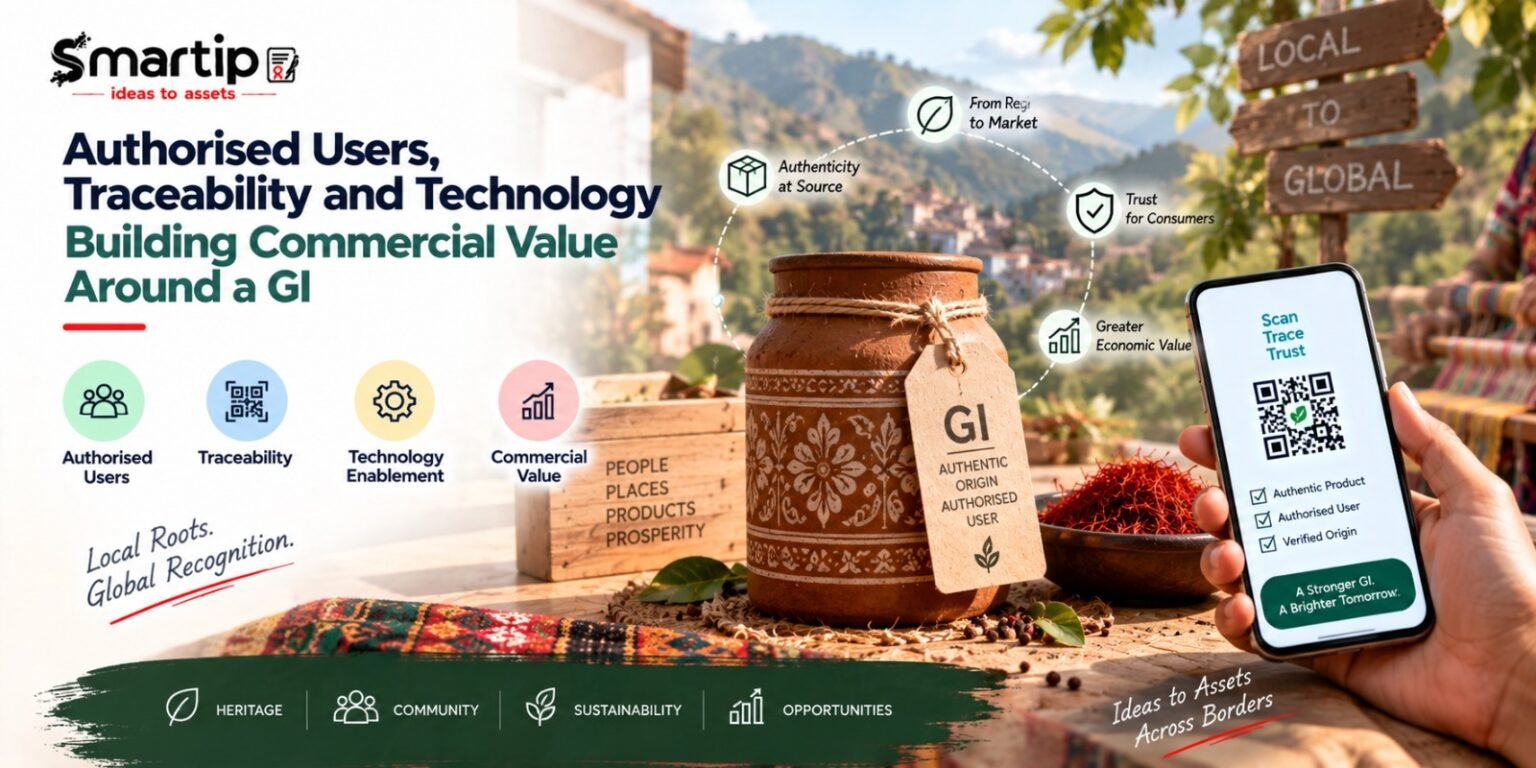
A GI becomes economically meaningful when genuine producers can use it, customers can trust origin and the market can distinguish authentic goods. This practical guide explains authorised-user participation, traceability, digital tools, packaging and startup opportunities around Indian GIs.
The commercial strength of a GI depends on producer participation
Registration creates legal recognition, but the daily economic value of a GI is created through producers. They make, process, trade or otherwise participate in the goods connected to the geographical origin. If genuine producers remain disconnected from the formal system, the GI can become more visible on government lists than in actual markets.
Authorised-user registration is therefore one of the most important operational parts of the Indian GI framework. The Act allows producers associated with a registered GI to apply for registration as authorised users. IP India’s current materials also explain this route.
For producer organisations, the challenge is awareness and accessibility. Producers need to know what authorised-user status does, what documentation is required and how it supports legitimate use of the GI. A commercialisation programme should include this education from the beginning.
Legal identity linked to origin.
Recognised genuine producers.
Evidence of conformity and process.
Origin and batch visibility.
Packaging, storytelling and channels.
Authorised-user status should not be treated as a certificate exercise
When authorised-user registration is understood only as paperwork, producer uptake may remain low. The better approach is to explain the commercial function: formal recognition supports legitimate association with the GI and helps create a clearer distinction between genuine producers and outsiders who misuse the geographical indication.
Producer associations can hold local-language workshops, create simple documentation guides and coordinate filing support. Universities can help prepare explanatory materials and digital tools without taking over the producer organisation’s role.
Progress should be measured by participation: how many genuine producers understand the GI, how many authorised users are active, and whether the market can identify them.
Traceability begins with one simple question: what needs to be proved?
Technology projects often begin with the solution—blockchain, QR code, mobile app—before defining the trust problem. A better approach starts with what a buyer or regulator needs to know. Was the product produced in the relevant geography? By whom? Under which batch? Were the key production steps followed? Can the information be checked without creating excessive burden?
Different GI goods need different traceability depth. A handicraft may need artisan and production-location records. An agricultural product may need farm, processing and batch information. A natural product may need extraction or collection records.
The technical system should follow the evidence requirement rather than forcing every GI into the same digital template.
QR codes are useful only when the underlying data is trustworthy
A QR code can connect customers to producer stories, authorised-user information, batch details or authenticity records. But a QR code does not create truth. If the database behind it is incomplete or anyone can generate a code without verification, the visual technology may create false confidence.
Strong systems need governance: who enters data, who validates it, what happens when goods change hands, and how errors are corrected. The system should also work for producers with limited digital infrastructure.
For students, this is an excellent systems-design challenge because it combines user experience, data architecture and governance rather than only coding.
Packaging should make the producer visible
Many GI commercialisation models fail when packaging focuses entirely on a distributor or platform and hides the producer. The result may increase sales without strengthening recognition of the producer community.
A better design balances the producer’s own mark, the GI identity, authenticity information and mandatory product labelling. Packaging should explain origin without creating the false impression that the GI belongs to the private seller.
Design students can build scalable templates so small producers obtain professional presentation without losing individual identity.
The marketplace that hid the artisans
A startup builds an online marketplace for a GI-linked handicraft. Product photographs are attractive, but every item is sold under the marketplace brand and the individual producer is almost invisible.
The startup redesigns the experience. Each product now identifies the artisan or producer, explains the geographical link, shows authenticity information and allows the platform brand to remain a service identifier rather than replace the GI identity.
The change increases trust while keeping the community, not the platform, at the centre of the story.
Technology can reduce authentication cost
Authenticity checking can be expensive when it depends entirely on manual inspection. Digital records, serialisation, image comparison or other technical tools may reduce cost when properly designed.
For some products, physical characteristics may also support scientific verification. Materials, composition, pattern or processing signatures could potentially be documented through appropriate testing. Such techniques should complement, not replace, producer and origin records.
Engineering and science students can therefore contribute to GI ecosystems through low-cost verification tools, packaging technology, post-harvest systems and quality measurement.
Data governance matters even in a producer-focused system
A traceability platform may collect producer names, contact details, location, production volumes, payment information or certification records. That creates data-governance responsibilities separate from GI law.
Technology teams should collect only what the system genuinely needs, define access controls and explain how records are used. Producer trust can be damaged if a platform commercialises sensitive production data without transparency.
Startups should therefore treat privacy, cybersecurity and producer contracts as part of the technical design.
E-commerce monitoring can help protect the GI
Digital marketplaces make it possible to search large numbers of listings and identify possible misuse. Producer associations can use structured monitoring to find sellers who describe goods using the GI while providing no credible origin information.
Technology can assist by generating search alerts, matching spelling variations and recording evidence. Human legal review is still required before enforcement decisions are made.
Monitoring should be proportionate. The objective is to protect genuine market identity, not create unnecessary disputes with every seller who uses similar descriptive language.
Export markets need both protection and operational readiness
GI products often attract export interest because origin and authenticity can support premium positioning. But legal recognition in India does not automatically create identical rights in every destination country.
Producer organisations should identify priority foreign markets and obtain advice on available protection routes. At the same time, they must address export-quality consistency, packaging, labelling, logistics and importer requirements.
A commercially successful GI export programme therefore combines IP strategy with supply-chain execution.
Universities can become neutral technology partners
Universities are well placed to help GI communities because they can bring engineering, design, business, agriculture, food technology and law students into one project. A multidisciplinary lab can map producer needs, create simple traceability tools, improve packaging and study market access.
The institution should avoid assuming ownership over the geographical indication or displacing the producer association. Its role is to create technology and knowledge that strengthens the ecosystem.
Such projects can also become excellent student startup opportunities where the resulting platform or service has wider applicability beyond one GI.
Startups should build around the GI, not on top of it
A startup can own its traceability software, packaging technology, marketplace brand or logistics service. It can license these tools to producer organisations and create a sustainable business. What it should not do is imply that it privately owns the community-linked GI or that only goods sold through its platform are genuine unless that claim is legally and factually justified.
Contracts should clarify data, service fees, branding, authenticity responsibilities and producer participation. The business model should make the producer community stronger rather than more dependent.
This approach creates a defensible startup asset while respecting the legal nature of the GI.
Authorised-user renewals require active management
The GI Act provides that registration of an authorised user runs for ten years or until the underlying GI registration expires, whichever is earlier, and provides renewal mechanisms. Producer organisations should therefore maintain a simple docket of authorised-user registrations and renewal dates.
This administrative work is commercially important because outdated records weaken trust. A digital producer register can help associations know who is active, who needs renewal support and which producers have changed contact details.
Technology should simplify compliance rather than create a second bureaucracy.
Producer onboarding should be designed like a service, not a legal form
If authorised-user participation is important, the onboarding experience deserves the same attention a startup gives a customer journey. Producers should know what documents are needed, who can help, how long the process may take and what happens after registration.
Local-language guidance, assisted digital filing, village-level workshops and status tracking can reduce friction. Universities or startups can build these service layers while the producer organisation retains governance.
The best system is one that makes compliance understandable to a small producer without requiring specialist legal knowledge for every routine step.
Traceability should have an offline fallback
Many GI regions have uneven connectivity or producers who do not use smartphones continuously. A traceability system that fails without internet access may exclude the very producers who need it most.
Offline identifiers, printable labels, batch books and later synchronisation can provide resilience. The technology architecture should reflect local operating conditions rather than assume urban digital infrastructure.
This is an excellent engineering challenge for student teams because success can be measured through adoption and reliability, not only software sophistication.
Customer-facing authenticity should be understandable in seconds
A consumer should not need to read a legal specification to understand why a product is authentic. A well-designed page can show the producer, place, batch or relevant origin story immediately, with deeper information available for buyers who want it.
Good information architecture separates marketing claims from verifiable facts. The platform can tell a story while making clear which fields come from producer records, inspection or authorised-user information.
This transparency strengthens trust and makes the GI commercially meaningful outside the originating region.
Producer identity should survive aggregation
Aggregation can improve logistics and bargaining power, but it can also make individual producers invisible. If a platform or exporter consolidates goods from many authorised users, the system should still preserve enough information to trace the product back to its genuine source. This is particularly important when quality differences, artisan techniques or batch characteristics matter commercially.
A practical model can use producer codes, batch identifiers and shared packaging rules while still allowing the aggregator to manage fulfilment. The goal is to combine scale with transparency rather than treating them as opposites.
For startups, this creates a product-design challenge: build operational efficiency without erasing the producer identity that gives the GI its authenticity.
Technology projects should budget for maintenance, not only launch
Many digital GI pilots fail after the initial grant or university project ends. The prototype works, the QR code scans, and the demonstration attracts attention, but nobody is assigned to update producer records, replace damaged labels, handle user support or pay for hosting.
A sustainable system needs an operating model. Who maintains the database? Who approves new producers? Who funds labels and support? What happens when a producer leaves or a batch is recalled? These questions should be answered before technology is deployed at scale.
Students should therefore include a maintenance plan in the project report. Startups should build recurring service economics rather than depend indefinitely on subsidies.
Quality data can become a market-development asset
When producers collect reliable quality information over time, the data can support more than compliance. It can reveal seasonal variation, identify process improvements, support buyer negotiations and help associations demonstrate consistency to export customers.
However, governance matters. Producer-level data can be commercially sensitive. The association should define who can access aggregated statistics and whether individual records can be used for pricing, credit or other purposes.
A well-designed system can generate collective intelligence without allowing one platform to exploit producer data unfairly. This balance should be built into contracts and technology architecture.
GI technology can itself create separate intellectual property
A startup or university team may develop a novel authentication device, packaging structure, software platform, image-analysis method or processing tool while supporting a GI ecosystem. Those technologies can raise separate patent, design, copyright or trademark questions.
This does not change ownership of the GI. It simply means that the service layer around the GI can contain its own intellectual property. Clear contracts should distinguish the community-linked geographical indication from technology created by the service provider.
This separation is commercially healthy: producers retain the collective identity, while innovators can build protectable tools that may later serve multiple GI communities.
Measure success through producer outcomes
A GI technology project should define success before deployment. Useful indicators can include authorised-user participation, time required to verify origin, producer share of final selling price, reduction in counterfeit or misleading listings, repeat orders, buyer confidence and the percentage of products carrying reliable traceability information.
Without such measures, teams may mistake technical activity for commercial impact. A sophisticated platform can generate thousands of scans while producer income remains unchanged. Conversely, a simple packaging and verification system may create substantial value if it helps buyers distinguish genuine goods and gives producers stronger negotiating power.
Universities can help establish baseline data and evaluate outcomes objectively. Startups can use the same metrics to prove that their service creates value worth paying for. In both cases, measurement keeps the technology connected to the original purpose of the GI: protecting a geographically rooted reputation and enabling genuine producers to benefit from it.
That focus on outcomes also improves governance because producers can see whether the system is helping them in practice, while associations gain evidence for deciding which tools should be expanded, redesigned or discontinued.
It also makes funding proposals more credible because future targeted public or private support can be tied to measurable producer and market improvements.
A five-question test for any GI technology project
- Does the project make genuine producer identity easier to verify?
- Does it reduce rather than increase producer burden?
- Does it help quality or origin information become more trustworthy?
- Does it improve market access or consumer understanding?
- Does it preserve the collective nature of the GI rather than privatise it?
If a proposed platform cannot answer these questions positively, the team should reconsider the design before adding more technology.
SmartIP takeaway
The strongest GI systems combine law, producer participation, quality, traceability and market design. Authorised users create a bridge between registration and genuine production. Technology can then make that bridge visible and trustworthy.
For students, GI commercialisation offers unusually rich multidisciplinary projects. For startups, it creates opportunities in authentication, packaging, logistics, digital marketplaces and export. The central principle should remain constant: technology should help authentic producers capture more value from the geographical identity they collectively sustain.
Official sources
This article is for general education and does not constitute legal advice on authorised-user registration, GI infringement, data protection or commercial contracts.